Finance and Accounting
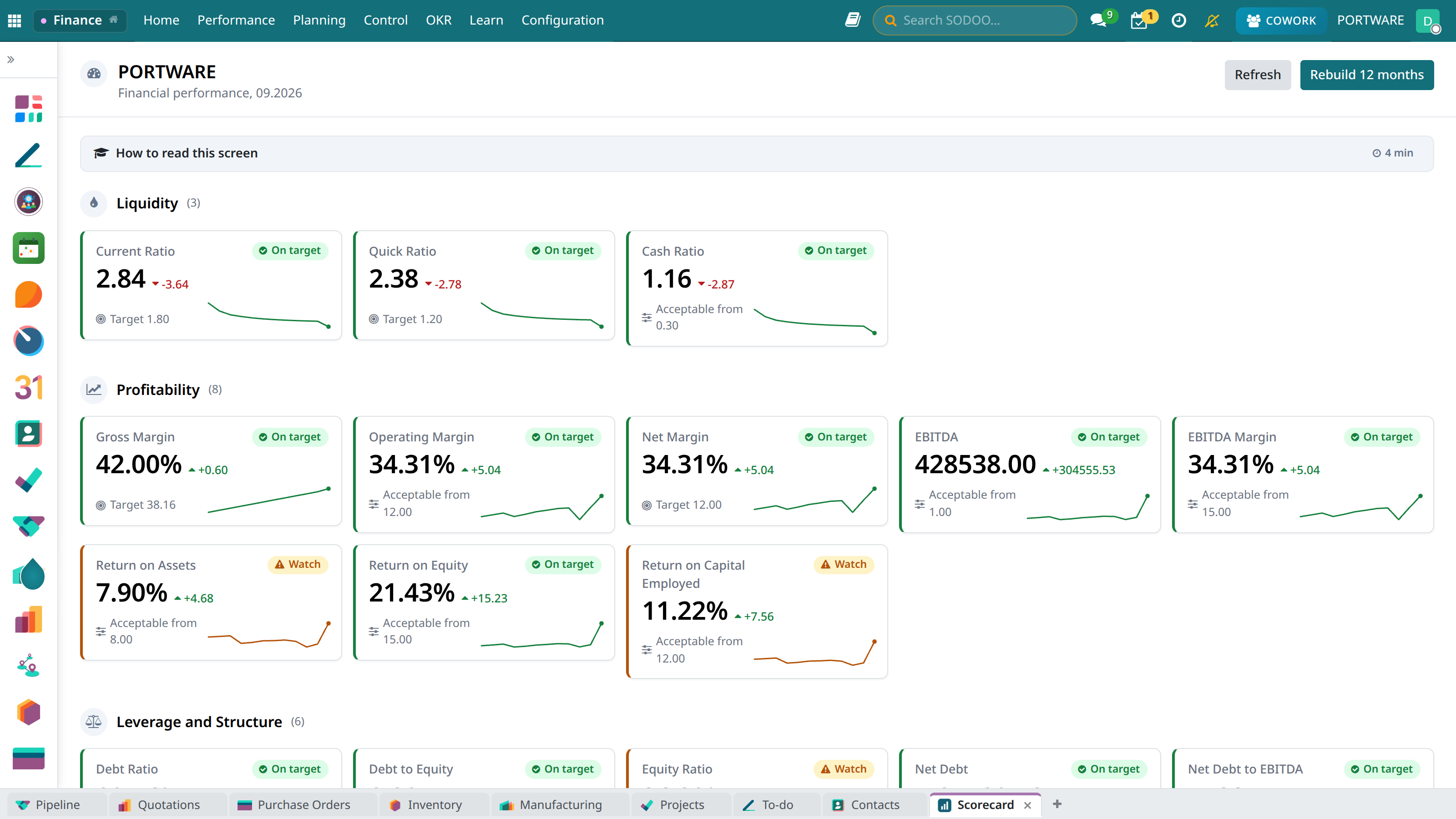
The SODOO Finance and Accounting module manages your business
What You Will Learn in This Section
- Understanding and applying double-entry bookkeeping
- Creating and managing the chart of accounts structure
- Issuing and tracking customer and vendor invoices
- Bank reconciliation and cash flow management
- Preparing the balance sheet, income statement and cash flow report
- Turkish accounting regulations and e-invoice integration
Overview
The SODOO Finance and Accounting module manages your business's Record-to-Report (R2R) process end to end. It brings all financial operations, from daily transactions to financial reporting, together on a single platform.
SODOO Invoicing vs SODOO Accounting
SODOO Invoicing
- Simple invoicing operations
- Customer and vendor invoices
- Basic payment tracking
- VAT calculation
- Ideal for small businesses
SODOO Accounting
- All the features of Invoicing +
- Double-entry bookkeeping
- Chart of accounts management
- Bank reconciliation
- Detailed financial reports
- Tax returns
- Budget management
The Record-to-Report (R2R) Process
Automatic Entries
Invoices, payments and stock movements create journal entries automatically.
Multi-Currency
Transactions in TL, USD, EUR and other currencies, with exchange difference calculation.
Multi-Company
Multi-company accounting and consolidation in a holding structure.
Real-Time Reports
An instant view of the balance sheet, income statement and cash flow.
Scenario: The Month-End Closing Process
Situation: January has ended. You need to make sure all invoices have been issued, payments recorded and bank reconciliation done, and then prepare the financial statements.
- Invoice check: Confirm all pending sales and purchase invoices
- Payment matching: Match open invoices with bank transactions
- Bank reconciliation: Reconcile all bank accounts
- Trial balance check: Verify that debit = credit
- Adjusting entries: Enter periodic entries such as depreciation and accruals
- Period lock: Close January for editing
- Reports: Produce the balance sheet and income statement
Accounting Basics
SODOO uses double-entry bookkeeping in line with international standards. Every transaction affects at least two accounts: a debit in one, a credit in the other.
The Double-Entry Principle
Total Debit = Total Credit must hold. If this balance is broken, the system does not let you post the entry.
Example: When a Sale Is Made to a Customer
The Journal Concept
Transactions are recorded in journals. Each journal is used for a specific type of transaction:
| Journal Type | Used For | Automatic Entry |
|---|---|---|
| Sales Journal | Customer invoices | When a sales invoice is confirmed |
| Purchase Journal | Vendor invoices | When a purchase invoice is confirmed |
| Bank Journal | Bank transactions | When a payment/collection is recorded |
| Cash Journal | Cash transactions | Cash payment/collection |
| Miscellaneous Journal | Adjustments, depreciation, accruals | Manual entry |
Chart of Accounts
The chart of accounts is the basic building block of accounting. All financial transactions are recorded in the accounts of the chart. In Türkiye the Uniform Chart of Accounts (TDHP) is legally mandatory.
Account Types and Code Ranges
Current Assets
Cash, Bank, Receivables, Inventory
Non-Current Assets
Fixtures, Buildings, Land
Short-Term Liabilities
Vendors, Taxes, Loans
Long-Term Liabilities
Long-term debts
Equity
Capital, Profits
Income
Sales, Interest Income
Expenses
Salaries, Rent, Electricity
Adding a New Account
Path: Accounting → Configuration → Chart of Accounts → New
| Field | Description | Example |
|---|---|---|
| Account Code | A unique code matching the type | 102.01 |
| Account Name | A descriptive name | İş Bankası TL Account |
| Account Type | Used by the system | Bank and Cash |
| Default Taxes | The VAT that applies to this account | VAT 20% |
| Tags | Grouping for reporting | Liquid Assets |
Invoicing
Invoices are the financial records of sales and purchases. In SODOO invoices create accounting entries automatically.
Creating a Customer Invoice
New Invoice
Accounting → Customers → Invoices → New
Choosing the Customer
Choose the customer in the customer field or create a new one
Adding Lines
Enter the product/service, quantity, unit price and VAT rate
Checking the Total
Verify the subtotal, VAT and grand total
Confirming
Issue the invoice with the Confirm button; the number is assigned automatically
Sending
Send the PDF invoice to the customer with Send by E-mail
Recording a Vendor Invoice
To record invoices received from vendors:
- Accounting → Vendors → Bills → New
- Choose the vendor and enter the invoice date
- Enter the invoice number as issued by the vendor
- Enter the products and amounts (they can be pulled automatically from the purchase order)
- Save with Confirm
Invoice States
| State | Description | Accounting Effect |
|---|---|---|
Draft |
The invoice is not confirmed yet and can be edited | None |
Posted |
The invoice is issued and a number assigned | A journal entry was created |
Partially Paid |
Part of the invoice has been paid | A payment entry was created |
Paid |
The invoice is fully closed | The receivable/payable account is cleared |
Cancelled |
The invoice was cancelled | A reversing entry was created |
Payment Management
Manage customer collections and vendor payments. Payments are matched with the related invoices automatically.
Ways to Record a Payment
Payment from the Invoice
Open the invoice → click the Register Payment button → enter the amount and method.
Bank Reconciliation
Import the bank transactions → match them with the related invoices automatically.
Manual Payment
Create a standalone payment with Accounting → Payments → New.
Batch Payment
Select several invoices → Action → create a batch payment.
Partial and Over-Payment
| State | Example | Action |
|---|---|---|
| Full Payment | Invoice: 10,000 TL, Payment: 10,000 TL | The invoice becomes "Paid" automatically |
| Partial Payment | Invoice: 10,000 TL, Payment: 6,000 TL | The invoice is "Partially Paid", remaining: 4,000 TL |
| Over-Payment | Invoice: 10,000 TL, Payment: 12,000 TL | 2,000 TL stays as an advance/credit |
| Several Invoices | Total of 3 invoices: 15,000 TL, Payment: 15,000 TL | All invoices are matched automatically |
Scenario: A Batch Vendor Payment
Situation: There are 5 pending invoices from ABC Tedarik Ltd., 47,500 TL in total. You will pay all of them with a single bank transfer.
- Go to Accounting → Vendors → Bills
- Filter: Vendor = ABC Tedarik Ltd., State = Pending
- Select all the invoices (checkbox)
- Action → Register Payment
- Payment method: Bank Transfer, Amount: 47,500 TL
- Save with Confirm
Bank Operations and Reconciliation
Define your bank accounts in SODOO, import the transactions and match the entries with automatic reconciliation.
Defining a Bank Account
Path: Accounting → Configuration → Journals → Bank Journals
| Field | Example Value |
|---|---|
| Journal Name | Türkiye İş Bankası - TL Account |
| Account Number (IBAN) | TR12 0006 4000 0011 2345 6789 00 |
| Currency | TL |
| Bank | Türkiye İş Bankası - Levent Branch |
| Accounting Account | 102.01 - İş Bankası TL |
The Bank Reconciliation Process
Uploading the Statement
Import the statement file you received from the bank (CSV/OFX/QIF)
Automatic Matching
The system matches similar amounts and references automatically
Manual Matching
Link unmatched entries manually with the related invoice/payment
Creating a New Entry
Create an income/expense entry for transactions without an invoice
Closing the Reconciliation
When all lines are matched, check the balance and close
Automatic Matching Rules
You can define automatic matching rules for recurring transactions:
- Partner matching: Recognising the customer/vendor by IBAN or reference
- Account assignment: Choosing the account by a keyword in the description
- Applying tax: Automatic VAT for certain transaction types
Financial Reports and Analysis
SODOO offers financial statements in line with international accounting standards and detailed analysis reports.
Core Financial Statements
Balance Sheet
Path: Accounting → Reporting → Balance Sheet
Income Statement (Profit & Loss)
Path: Accounting → Reporting → Profit and Loss
Filtering Reports
| Filter | Options |
|---|---|
| Date Range | Today, This Month, This Quarter, This Year, Custom Range |
| Comparison | Comparison with last year, last month, the budget |
| Account Group | Show only specific account types |
| Analytic Tags | By project, department, cost centre |
| Export | PDF, Excel, CSV formats |
Budget Management
Define budgets by department, project or account, and keep financial control by comparing them with actual values.
Creating a Budget
Path: Finance → Budgets → New (Accounting → Budgets leads to the same screen)
- Enter a code and a name, set the start and end dates
- Choose a Scenario: Base, Optimistic or Pessimistic
- Add lines — each line targets a measure (for example: Marketing Expenses), optionally with a cost centre
- Enter the monthly amounts in the Budget Grid
- Submit → the finance manager Approves
The budget's life cycle
An approved budget is read-only. For a change a new revision is opened; the old version stays as evidence. There can be only one approved budget for the same company, period and scenario.
Budget overrun warnings
Warnings are managed not from a separate menu but from the budget's own Control Policy field:
| Policy | If a document exceeds the budget |
|---|---|
| Off | Nothing happens; the budget is only a plan |
| Warn (default) | The document passes, the overrun is recorded, a note is left in the document's chatter |
| Block | The document is not confirmed; the message states the plan, the spent amount, the commitment and the overrun |
The moments checked: purchase order confirmation, vendor bill posting and expense approval. Recorded overruns sit in the Finance → Budget Overruns list. Only the approved base budget controls; an unbudgeted or ambiguous account never blocks.
Tax Operations
Automatic calculation and reporting of VAT, withholding and other taxes.
VAT Rates in Turkey
| VAT Rate | Used For | Examples |
|---|---|---|
| %20 | General rate | Most goods and services |
| %10 | The reduced rate | Food, textiles, residential rents |
| %1 | Heavily reduced | Some agricultural products |
| 0% (Exemption) | VAT exemption | Exports, transit trade |
VAT Return
Path: Accounting → Reporting → Tax Report → VAT Return
Turkish Localisation
SODOO offers a localisation package fully compliant with Turkish accounting regulations.
The Uniform Chart of Accounts (2KB)
A standard chart of accounts in line with the Turkish Commercial Code and tax regulations:
- Settings → Accounting → Fiscal Localisation
- Tick the "Türkiye - TDHP Chart of Accounts" option
- Click the Install button
- The system sets up 500+ accounts automatically
E-Invoice and E-Archive
An e-document system integrated with the GİB (Revenue Administration):
E-Invoice
Invoices issued to companies registered for e-invoicing. Digital sending through the GİB.
E-Archive
For customers not registered for e-invoicing. Sent by e-mail as a PDF.
E-Waybill
The digital version of shipping documents. Mandatory during transport.
E-Self-Employment Receipt
A digital receipt system for the self-employed.
Setting Up the GİB Integration
Path: Settings → Integrations → GİB Connection
| Parameter | Description |
|---|---|
| Integrator | İzibiz, Sebit, Foriba, Logo etc. |
| Test/Live Environment | Use the test environment for the first setup |
| User Name | The user name obtained from the integrator |
| Password/API Key | The integrator's API key |
| Tax Number | 10-digit tax number (VKN) |
Configuration and Settings
Configure the general settings of the accounting module to your business needs.
Basic Settings
Path: Settings → Accounting
| Setting | Description | Default |
|---|---|---|
| Default Currency | The company's main currency | TL |
| Multi-Currency | Allow foreign-currency transactions | Off |
| Analytic Accounting | Cost centre/project tracking | Off |
| Budget Management | Budget planning and control | Off |
| Asset Management | Fixed assets and depreciation | Off |
Fiscal Year Settings
Path: Accounting → Configuration → Fiscal Years
- New fiscal year: Set the start and end dates
- Periods: Define monthly or quarterly periods
- State: Mark as Open/Closed
- Period lock: Close completed periods for editing
Frequently Asked Questions
How do I change the invoice number sequence?
Choose the relevant journal from the Accounting → Configuration → Journals menu. You can change the number format in the "Sequence" field:
- %(year)s - Year (2026)
- %(month)s - Month (01-12)
- %(seq)04d - Sequence number (0001, 0002...)
Example: FTR/%(year)s/%(seq)05d → FTR/2026/00001
How is the exchange rate set on a foreign-currency invoice?
For foreign-currency invoices the rate is set in this order:
- If a rate is defined on the invoice date, it is used
- Otherwise the most recently entered rate is taken
- If there is no rate at all, 1:1 is assumed
Updating rates: You can enter them manually from the Accounting → Configuration → Currency Rates menu or set up automatic updates.
How do I correct a wrongly confirmed invoice?
A confirmed invoice cannot be edited, but there are two ways:
- Credit note: Issue a credit note in the opposite direction
- Reset to draft: If there is no payment, cancel the invoice and reset it to draft
Caution: If the e-invoice has been sent, follow the GİB procedures for cancellation.
What should I do with an unmatched line in bank reconciliation?
For an unmatched bank transaction:
- If it has an invoice: Select the related invoice manually and match it
- If it has no invoice: Create a new income/expense entry (e.g. a bank charge)
- If it is a wrong entry: Consult the bank or make a correcting entry
What is analytic accounting for?
Analytic accounting lets you follow income and expenses along different dimensions:
- Cost centre: Expense tracking by department
- Project: Project profitability analysis
- Region: Geographic performance comparison
Activation: Settings → Accounting → Analytic Accounting
How is a period closed?
Month-end or year-end closing steps:
- Confirm all invoices
- Complete the bank reconciliation
- Enter the adjusting entries (depreciation, accruals)
- Check the trial balance (Debit = Credit)
- Lock the period from Accounting → Configuration → Fiscal Periods
What should I do if an e-invoice is rejected?
When an e-invoice is rejected:
- Check the reason for rejection (usually a wrong tax/ID number)
- Correct the customer details
- Cancel the invoice and create it again
- Send it again as an e-invoice
Common reasons for rejection: Wrong tax ID, invalid IBAN, a missing mandatory field
How is consolidation done in multi-company accounting?
For consolidation in a holding structure:
- Define a separate database or company for each company
- Track inter-company transactions in the "Inter-Company" journal
- Get the consolidation reports from Accounting → Reporting → Consolidated
- Elimination entries are created automatically