Lesson 2 · Part and engineering code
The engineering code never changes, the revision grows with each change; new code or new revision.
Goal of this lessonTo know the difference between the engineering code and the revision, and to decide whether a change needs a new code or a new revision.
Code and revision
The engineering code is the part's number and never changes. A new version of the part keeps the code and its revision number goes up by one: 0, 1, 2… Code and revision together name one exact design: PW-BRK-80 rev 1 is the bracket's second version. A released revision is never edited; a change means a new revision.
Step by step
Find the code and revision on the part form
The part number field shows the code and the revision together (
PW-KIT-750 - Rev_ 0). A new revision opens as a separate record under the same code; the old revision's record stays as history. 12345
12345- State: Released.
- The guide box says which revision a change will make (here revision 1).
- Request a Change: the one door to a new revision.
- Code + revision.
- Take Baseline: a snapshot of the structure as it is now.
See every revision of a part
Remove the Latest filter in the part list: old and new revisions of the same code come side by side. The bracket's rev 0 is Under Modify (rev 1 in work), the plate's rev 0 is Obsoleted (rev 1 released).
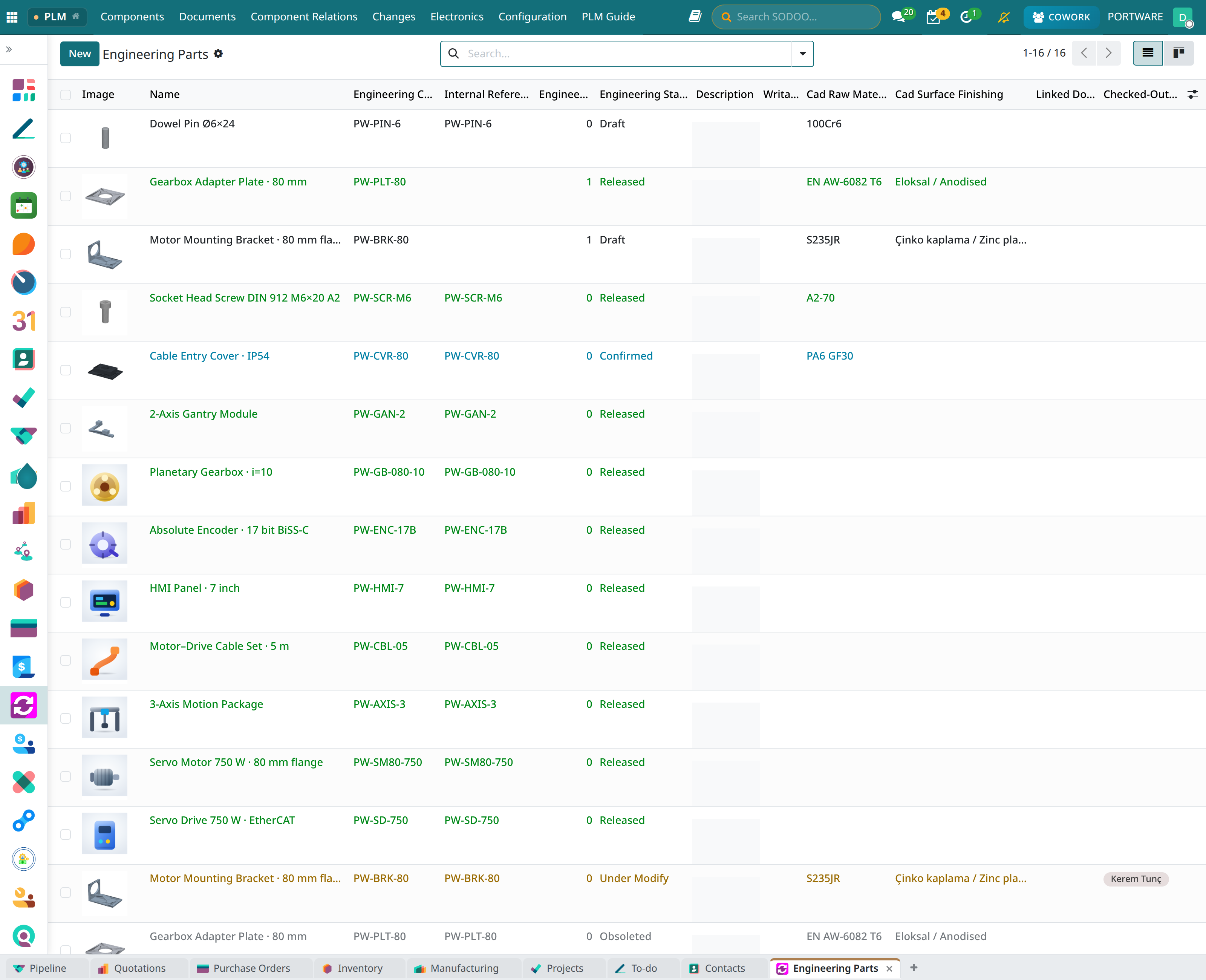 1234
1234- Search bar: the Latest filter removed.
- Revision column.
- PW-BRK-80 rev 0: Under Modify — valid until the new one is released.
- PW-PLT-80 rev 0: Obsoleted — replaced by rev 1.
The rule: form, fit, function
If the new part fits in place of the old one with no other change — same outer dimensions and interfaces (form, fit) and the same job (function) — it is a new revision. If it does not, if an assembly must change with it, it is a new engineering code; the old code is made obsolete when needed. The users of the part decide, not the part: if old and new can be mixed in stock, the code stays the same.
Mini case: the plate from 8 mm to 10 mm
- Change
- The adapter plate bends under load; thickness 8 → 10 mm.
- Question
- Does the new plate fit in place of the old? Holes and outline unchanged, the screws are long enough: yes.
- Decision
- New revision: PW-PLT-80 rev 1 (released by ECO-2026-0002).